
First month · Pacifiers & bottles
When should you introduce a pacifier and a bottle?
Why we suggest waiting about three weeks for a pacifier and a bottle, what the research says, and how paced bottle feeding keeps your baby happy at the breast.
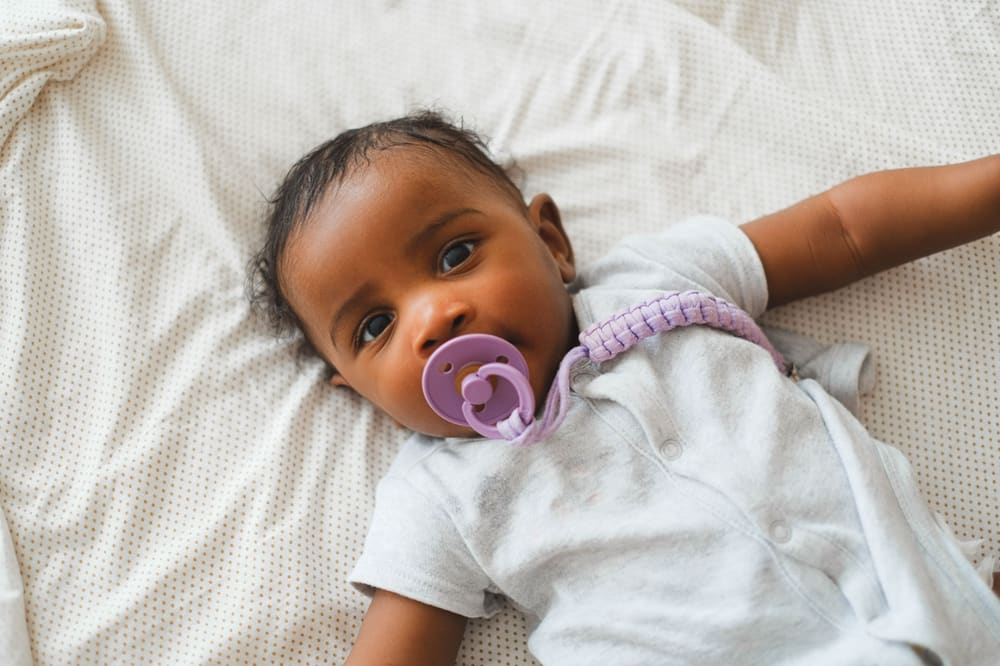
The worry usually runs in both directions at once.
Give a pacifier or a bottle too early and your baby might prefer it to the breast. Wait too long and she might refuse the bottle entirely — which, for a mother who needs to go back to work or simply wants an evening out, is a genuinely frightening thought.
Depending on who you ask, pacifiers are either a lifesaver or the villain. As with most parenting questions, the useful answer isn’t a rule handed down by someone else — it’s knowing enough to decide what you want to do.
Pacifiers
Our recommendation: wait about three weeks, until breastfeeding is well established.
The reason is mostly about information. A pacifier makes feeding cues harder to read — a baby who’s sucking looks content, so the early hunger signs slip past and you end up feeding later and less often than your baby needs. In the weeks when your supply is still being set, that matters.
There’s also some evidence of higher rates of ear infections and oral thrush with pacifier use.
The other side is real too: the American Academy of Pediatrics notes a possible lower rate of SIDS and SUID when a pacifier is used for naps and sleep — and also recommends waiting until breastfeeding is established, at around three to four weeks.
So: if your baby is fussy in those first weeks, try a feed first, then other comfort measures. Reach for the pacifier once feeding is going well and you can read her cues without it.
What other experts say:
Bottles
Most babies go back to the breast after a bottle without any trouble. The part that makes the difference is how the bottle is given.
Here too, three to four weeks after birth is a good point to start — once you know breastfeeding is going well.
When a baby does start refusing the breast, it’s usually about speed rather than preference. If the bottle flows fast — because of how she’s positioned or because the nipple is too quick — she gets used to milk arriving that easily, and then puts her little foot down when the breast doesn’t do the same. It isn’t that she’s chosen the bottle. It’s that one of them stopped feeling like work.
Which is good news, because flow is something you control.
Paced bottle feeding
Paced feeding slows the bottle down to something closer to the breast, so going back and forth stays easy.
- Sit your baby upright rather than lying her down.
- Use the slowest-flow nipple you can find. Most babies do fine with a size 1 (newborn); some brands make a size 0, a preemie flow.
- Hold the bottle parallel to the floor, tilted just enough to fill the nipple with milk.
- As she drinks, tip the bottle down or take it out for a moment if she’s going too fast.
- Aim for a feed that lasts about as long as nursing does — roughly 15 to 20 minutes, though plenty of babies nurse longer than that.
If a feed still feels too fast once you’re doing all of this, the nipple is usually the culprit — try the next size down before changing anything else.
A demonstration is worth more than a list here:
Please reach out.
If you have questions or concerns about this, or simply want to talk it through, we're glad to. Every consult — in-home, clinic or virtual — starts with listening.
Schedule a consult